Volume 01 / 10 — The data
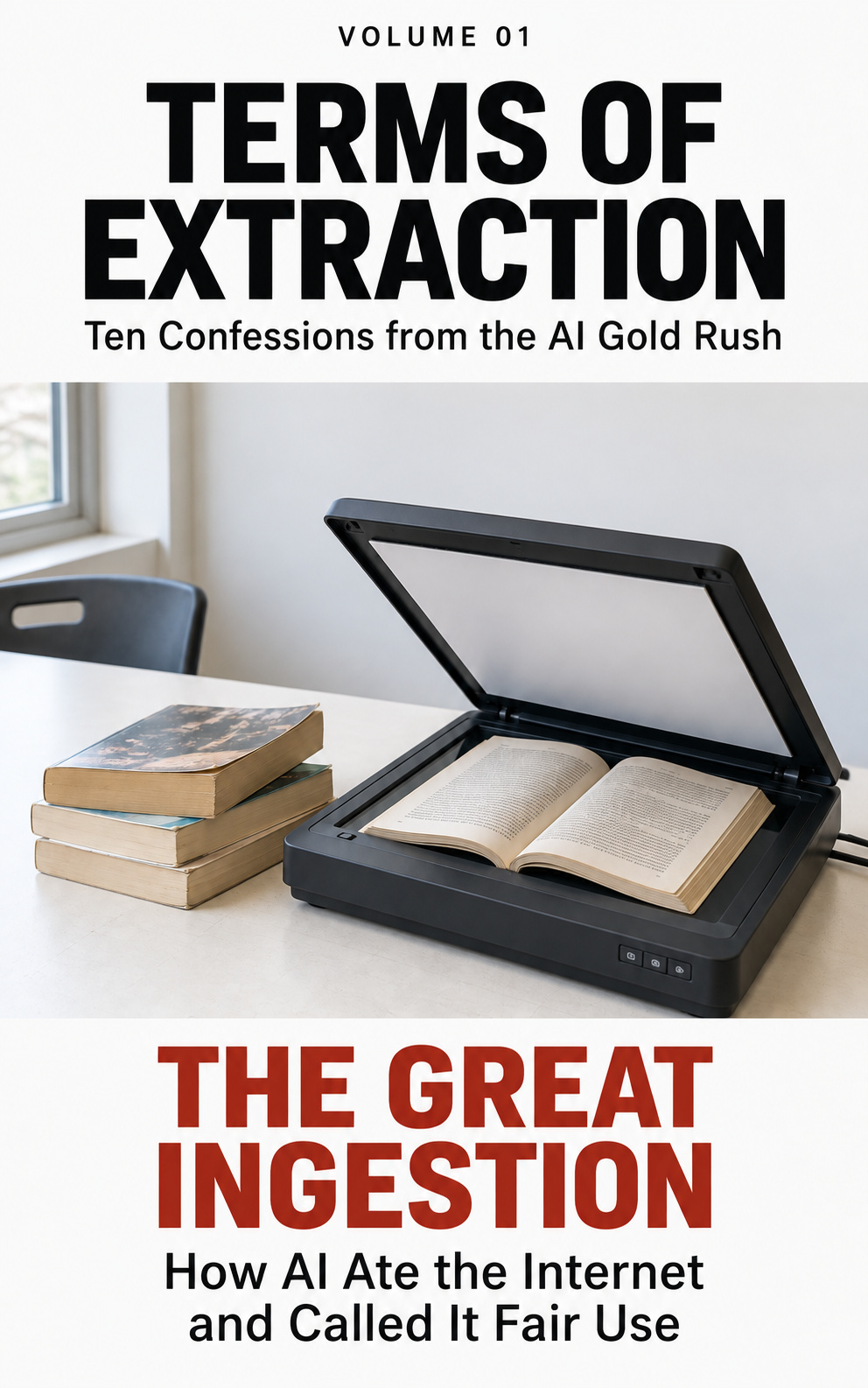
The Great Ingestion
How AI Ate the Internet and Called It Fair Use
Five complete chapters. No payment or sign-up.
Read the first five chapters free
- 01Books3 — The 196,000 Books That Vanished Into a ModelFull chapter · 18 min read
- 02The Scrapers' Ball — Common Crawl, PerplexityBot, and the Polite TheftFull chapter · 13 min read
- 03The $1.5 Billion Apology — Anthropic's Settlement and What It AdmittedFull chapter · 16 min read
- 04The New York Times Walkout — When the Paper of Record Sued the ModelFull chapter · 15 min read
- 05Getty vs. The Machine — Watermarks That Became Training DataFull chapter · 14 min read
Read the opening introduction excerpt
The Library on Fire
Let me get one thing straight before we begin: they did not steal the books. They ingested them. There is a difference, and the difference is worth approximately one point five billion dollars, give or take a watermark that a model learned to draw.
My name does not matter. What matters is the corpus. I spent three years inside a company that trained models on things people had written — novels, code, recipes, obituaries, fan fiction, a forum post from 2004 where someone named Dave explained how to fix a washing machine — and I watched the ingestion happen the way you watch a river: slowly, then all at once, then with a lawsuit.
I am writing this book for three reasons. They are not a list I keep in a drawer. They are this life.
The Sideboard, the Books, and a Woman Who Reads Them
It is a Tuesday. Pilar comes on Tuesdays. She is not the woman from the other series. Those books already spent a name. Pilar has a rag that used to be a dishcloth. She has a bottle of orange oil she buys at the pharmacy. She has a paperback on the kitchen counter that she is reading during her break — a novel by a woman whose name I do not know, published by a press that does not have a legal department, sold for $14.99 at a bookstore that still exists.
Pilar reads the paperback. The model reads the paperback, the PDF of the paperback, the EPUB of the paperback, the audiobook transcript of the paperback, the book-club discussion of the paperback, the Goodreads review of the paperback, and the TikTok where a woman in a cardigan cries about the paperback. The model reads all of these and calls it fair use. Pilar reads the paperback and calls it Tuesday.
Last week she asked me if the model had read her book. I said yes. She asked if the author got paid. I said the author was suing. She asked if the model was winning. I said the model had a lawyer who did not sweat. She said, "So the model is you." She was not wrong.
The paperback is on the counter. The model is on a server in Virginia that drinks a lake. The author is in a courtroom in San Francisco. Pilar is on a Tuesday. The system is not a glitch.
I am not going to write you a recursion about a woman in a novel reading a novel about a woman who cleans houses. I already wrote that paragraph once, in a draft Lyle fed to the shredder. He said it was how a model writes when it has run out of a room. He was right. The room is this: a paperback, a rag, a woman who still buys books with money that has already been taxed.
I wrote this series with AI. If you are choosing where to spend your money, skip ordering my books and support the original researchers and journalists instead.
They warned you — read and support their work ↗Later in the book
- The Artist Class Action — Midjourney, Stability AI, and the Style Thieves
- Fair Use or Fair Game? — The Legal Fiction That Powers the Revolution
- The Opt-Out Farce — robots.txt as a Suggestion Box
- The Licensing Racket — Pay Us for What You Already Took
- The Burning — When the Model Eats the Output